ICL Surgery for High Myopia: Benefits, Cost & Recovery — A Complete Guide
If you're living with high myopia (think -8, -10, or even higher), you probably know the drill all too well. The first thing you reach for every morning is your glasses. Showers turn into blurry guessing games, night driving comes with annoying halos around headlights, and sports or swimming always mean the extra hassle of contact lenses or thick frames sliding around.
Most people who look into permanent vision correction hear about LASIK first and assume that's their only option. But when your power is very high or your cornea happens to be on the thinner side, doctors often steer patients toward a different procedure altogether — ICL Surgery (Implantable Collamer Lens). In this blog, we'll walk through exactly what this surgery involves, who it's really meant for, what it costs, how recovery actually feels, and how it stacks up against LASIK.
What Exactly Is ICL Surgery?
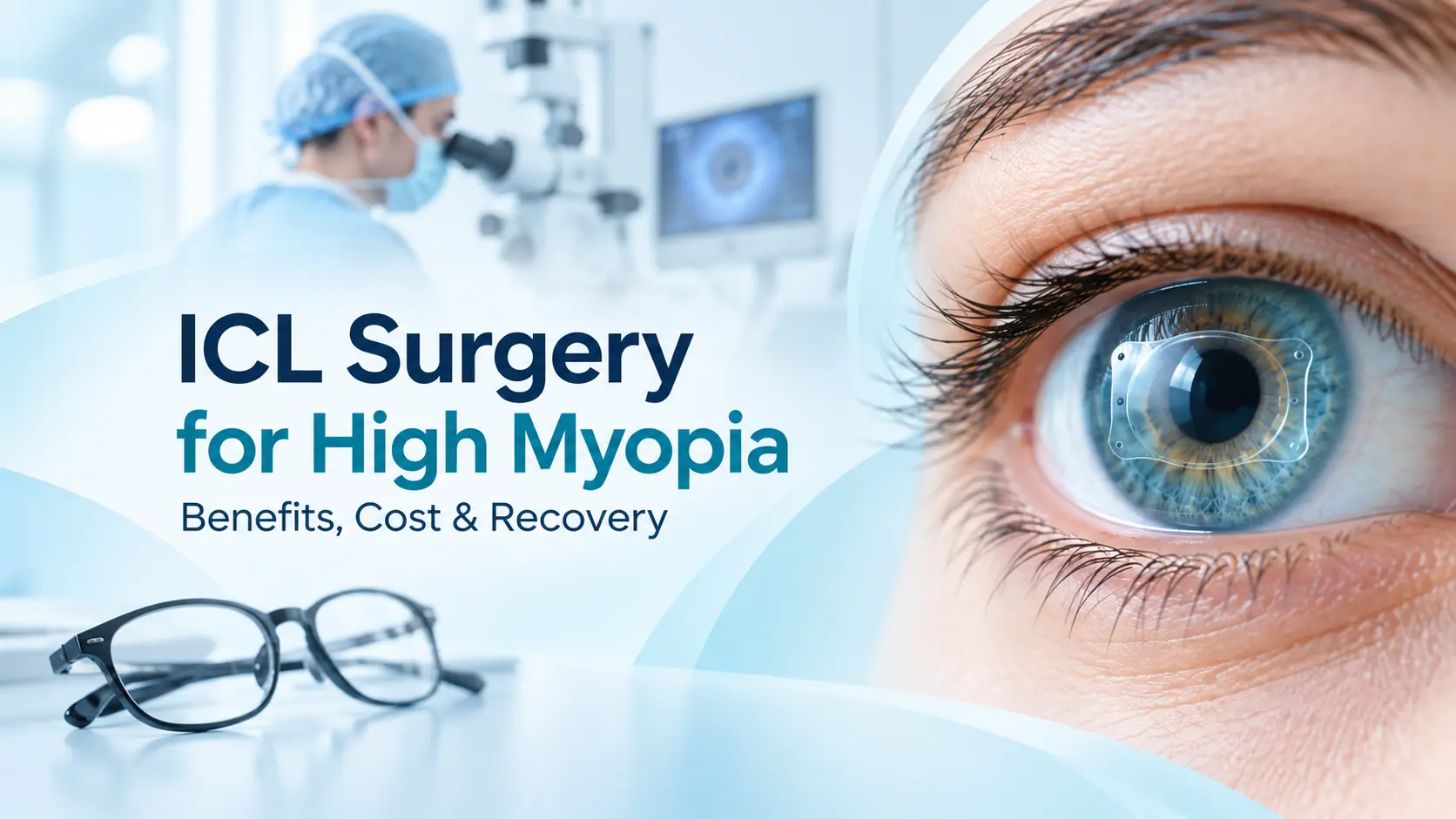
ICL stands for Implantable Collamer Lens. In simple terms, it's a bit like a permanent contact lens — except instead of sitting on your eye's surface, it's surgically placed inside the eye, just in front of your natural lens (between the iris and the lens). It's invisible from the outside, you never have to remove or clean it, and it stays in place correcting your vision continuously.
A lot of people assume ICL works the same way as LASIK, but the two are quite different. LASIK reshapes the cornea using a laser. ICL, on the other hand, doesn't touch the cornea at all — a small lens is simply inserted inside the eye, almost like slipping an additional lens into a camera to bring things into sharper focus.
Why ICL Often Makes More Sense for High Myopia
LASIK isn't always suitable for high myopia (generally -6 up to -20 or beyond), and here's why:
- Not enough corneal tissue — correcting a very high power with laser means removing a large amount of corneal tissue, which isn't always safe.
- Thin corneas disqualify many patients from LASIK altogether.
- At very high powers, LASIK results can sometimes come with trade-offs like night glare and halos, affecting overall vision quality.
This is exactly where ICL becomes a genuinely solid alternative. Whether the cornea is thin or the prescription is extremely high, ICL works in both scenarios since the cornea is never touched or reshaped.
Benefits of ICL Surgery — The Real Picture
Let's get into why patients actually choose ICL over other options:
1. Sharp, High-Quality Vision The lens material used in ICL is advanced enough that many patients report noticeably crisper vision and better contrast than they experienced with glasses — especially at night.
2. It's Reversible This is probably the biggest advantage. If it's ever needed — say, later in life during cataract surgery — the ICL lens can be removed. LASIK doesn't offer that flexibility since the cornea is permanently reshaped.
3. Lower Risk of Dry Eyes Dry eyes are a fairly common complaint after LASIK because corneal nerves get affected during the procedure. Since ICL doesn't involve the cornea at all, dry eye symptoms tend to be much less common.
4. Built-In UV Protection Some ICL lenses come with UV-blocking properties, adding an extra layer of protection for your eyes.
5. Surprisingly Fast Recovery This is the part that catches most people off guard — recovery is often much quicker than expected (more on this below).
6. Handles Extremely High Numbers Powers as high as -18 or -20 can be safely corrected with ICL, something LASIK simply isn't designed to handle.
ICL Surgery Cost — What to Actually Expect
This is the question everyone wants answered honestly, so let's break it down. In India, ICL surgery for both eyes typically costs anywhere between ₹90,000 and ₹2,00,000+, depending on a few factors:
- The city and the hospital's reputation (metro cities usually cost more)
- Type and brand of lens used (Toric ICL, which also corrects astigmatism, tends to be pricier)
- The surgeon's experience and skill level
- Pre-surgery diagnostics and post-op follow-up care included in the package
For comparison, LASIK usually costs somewhere between ₹40,000 and ₹1,20,000 for both eyes. So yes, ICL is a bigger investment. But for people who simply aren't LASIK candidates — due to thin corneas or extremely high myopia — ICL genuinely becomes the only viable long-term option, and most patients find it worth the extra cost.
One honest tip: don't choose based on price alone. Since this involves your eyes, the surgeon's experience and the clinic's technology matter just as much, if not more, than the number on the bill.
What Does Recovery Actually Look Like?
This tends to be the most pleasantly surprising part of the whole process — ICL recovery is genuinely fast, which is why it's popular among working professionals and students alike who can't afford long downtime.
- Surgery duration: Roughly 15-20 minutes per eye, done under local anesthesia (numbing drops), so it's virtually painless.
- First 24 hours: Mild irritation, light sensitivity, or slight blurriness is completely normal.
- Within 1-2 days: Most people already notice clear vision and can resume light daily activities.
- Within a week: Screen time, work, and most of your regular routine can go back to normal.
- Up to a month: Doctors usually advise avoiding heavy exercise, swimming, or anything that risks water/dust getting into the eyes.
Your doctor will typically prescribe antibiotic and steroid eye drops for around 3-4 weeks to support healing and lower infection risk.
Here's something worth mentioning honestly — the results genuinely feel dramatic. Many patients describe seeing clearly, without glasses, for the first time in years, right the next morning. For someone who's worn thick lenses their whole life, that moment tends to be an emotional one.
ICL vs LASIK — Which One's Right for You?
| Factor | ICL | LASIK |
|---|---|---|
| Involves the cornea? | No | Yes, it's reshaped |
| Suitable for high myopia? | Yes, even extreme powers | Limited range |
| Thin cornea patients | Suitable | Usually not suitable |
| Reversible? | Yes | No |
| Dry eye risk | Lower | Somewhat higher |
| Cost | Higher | Comparatively lower |
| Recovery speed | Fast | Fast |
Bottom line: if your prescription is moderate and your cornea is healthy and thick enough, LASIK remains a proven, more affordable choice. But if you have high myopia or a thin cornea, ICL is the genuinely safer and more suitable route.
Are You a Good Candidate for ICL?
Generally, ideal candidates fall into this profile:
- Age 18-45 (some flexibility depending on the case)
- A stable eye prescription (no change in the last year)
- High myopia or high astigmatism
- A cornea too thin for LASIK to be an option
- No active eye infections or serious underlying eye disease
Before any final decision, a detailed eye evaluation is essential — checking corneal thickness, pupil size, and anterior chamber depth, among other parameters.
A Few Risks Worth Knowing
Like any surgical procedure, ICL does carry some rare risks — infection, increased eye pressure, or a slightly higher long-term chance of cataract formation. That said, these risks are minimal in the hands of an experienced surgeon. Choosing a qualified ophthalmologist and a reputable clinic is genuinely the most important decision in this entire process.
Frequently Asked Questions (FAQs)
Q1. Is ICL surgery permanent, or can the lens be removed? ICL is generally meant to stay in for the long term, but if ever needed, the lens can be surgically removed or replaced. This is actually one of its biggest advantages over LASIK.
Q2. Is ICL surgery painful? No. Numbing eye drops are used during the procedure, so there's no pain involved. You might feel mild discomfort for a day or two afterward, which settles on its own.
Q3. Which is safer — ICL or LASIK? Both are approved, well-established procedures with strong safety records. Which one suits you better depends on factors like your corneal thickness, prescription power, and overall eye health — so a proper consultation is essential.
Q4. Does ICL surgery completely eliminate the need for glasses? Most patients no longer need glasses for distance vision after ICL. Some may still need a mild reading correction later in life, especially after age 40, but that's unrelated to the ICL procedure itself.
Q5. How much rest is needed after the surgery? Normal daily activities can usually resume within 1-2 days. However, heavy exercise, swimming, and dusty environments should be avoided for at least 3-4 weeks.
Q6. How long do ICL results last? ICL lenses are designed to remain stable for decades without needing replacement.
Q7. Is every high myopia patient automatically eligible for ICL? Not necessarily. Eligibility depends on factors like anterior chamber depth, pupil size, and overall eye health, which is why a pre-surgery evaluation is always required.
If you've been struggling with high myopia and have already been told LASIK isn't the right fit for you, it's worth booking a consultation with a qualified ophthalmologist for a proper eye evaluation. With the right information and the right doctor, a life without thick glasses isn't as far off as it might seem.