
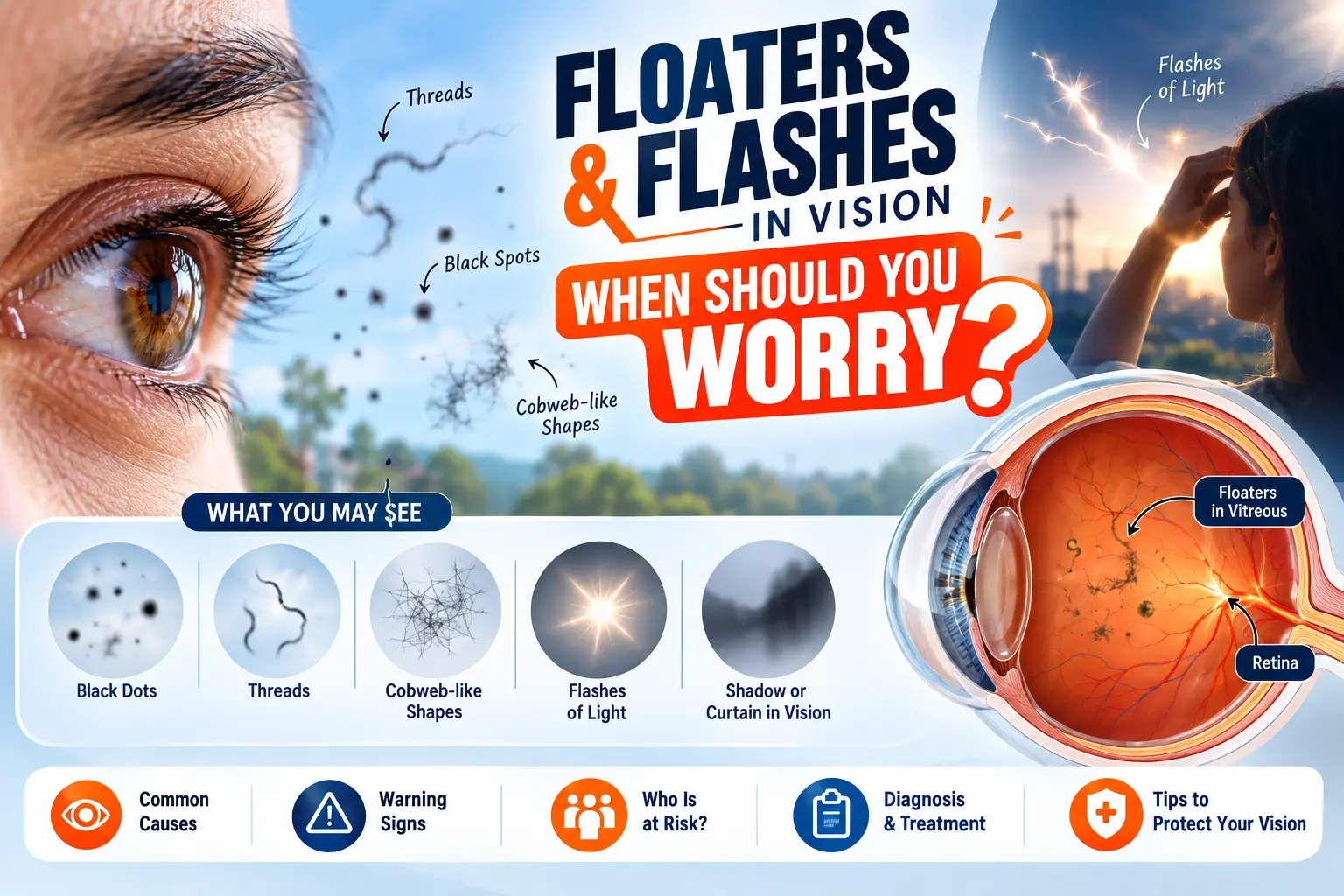
Floaters and Flashes in Vision: When Should You Worry?
Have you ever noticed small dots, threads, cobweb-like lines, or shadows moving across your vision?
These are commonly known as eye floaters.
Some people also experience brief flashes of light, flickering, or lightning-like streaks in their vision. These are called flashes.
In many cases, occasional floaters can be harmless. However, a sudden increase in floaters or flashes may sometimes indicate a problem involving the retina and should not be ignored.
Understanding the difference between common symptoms and warning signs can help protect your vision.
What Are Eye Floaters?
Floaters are small shapes that appear to drift across your field of vision.
They may look like:
- Small black or grey dots
- Threads or strings
- Cobweb-like lines
- Rings
- Tiny moving shadows
- Specks floating in front of the eyes
Floaters are often easier to notice when looking at a bright background such as a white wall, clear sky, or computer screen.
They may appear to move when you move your eyes and often seem to drift away when you try to look directly at them.
Why Do Eye Floaters Occur?
Inside the eye is a clear gel-like substance known as the vitreous.
As we age, this gel may gradually become more liquid and may form small clumps or strands.
These tiny structures can cast shadows on the retina, which may appear as floaters.
Age-related changes in the vitreous are among the most common reasons for floaters.
However, floaters may also occur in association with other eye conditions.
What Are Flashes in Vision?
Flashes are brief sensations of light that may appear even when there is no actual external light source.
Patients may describe them as:
- Lightning flashes
- Flickering lights
- Spark-like lights
- Flashing lines
- Sudden streaks of light
These flashes may occur when the vitreous pulls or tugs on the retina.
Occasional flashes can happen with normal changes inside the eye, but persistent or sudden flashes require evaluation.
Are Floaters Always Dangerous?
No.
A few long-standing floaters that remain stable over time are often associated with normal ageing changes inside the eye.
However, new or suddenly increasing floaters should be examined by an eye specialist because they can sometimes occur due to a retinal tear, bleeding inside the eye, inflammation, or retinal detachment.
When Should You Worry About Floaters and Flashes?
You should seek prompt eye evaluation if you experience:
Sudden Increase in Floaters
If many new floaters suddenly appear within a short period, especially if they look like a shower of black dots, an eye examination is recommended.
Sudden Flashes of Light
New flashes, especially when they occur repeatedly, may indicate that the vitreous is pulling on the retina.
A Curtain or Shadow Over Your Vision
If you notice a dark curtain, veil, or shadow moving across part of your vision, seek urgent eye care.
This can be a warning sign of retinal detachment.
Loss of Peripheral Vision
A reduction in side vision together with flashes or floaters may require immediate retinal examination.
Sudden Blurred Vision
New floaters associated with sudden blurred or reduced vision should not be ignored.
Can Floaters Be Related to Retinal Detachment?
Sometimes.
When the vitreous gel separates from the retina, it may occasionally pull strongly enough to create a small retinal tear.
Fluid can then pass through the tear and separate the retina from the underlying tissue.
This condition is called retinal detachment.
Retinal detachment can threaten vision and usually requires prompt treatment.
This is why sudden floaters, flashes, or a curtain-like shadow should be evaluated quickly.
Who Is More Likely to Develop Floaters?
Floaters may become more common with age, but certain people may be at higher risk.
These include people who:
- Are highly short-sighted
- Have undergone cataract surgery
- Have experienced eye trauma
- Have diabetes
- Have inflammation inside the eye
- Have a history of retinal problems
- Have previously experienced retinal tears or detachment
If you belong to any of these groups, new visual symptoms should be taken seriously.
Can Diabetes Cause Floaters?
Yes, in some cases.
Diabetic eye disease can damage blood vessels in the retina.
If these blood vessels leak or bleed into the vitreous, a person may notice sudden dark spots, clouds, or floaters.
People with diabetes should therefore have regular dilated retinal examinations as advised by their eye specialist.
How Are Floaters and Flashes Diagnosed?
An ophthalmologist may perform a detailed eye examination that can include:
- Visual acuity testing
- Slit-lamp examination
- Dilated retinal examination
- Intraocular pressure measurement
- Retinal imaging, when required
- OCT or ultrasound in selected cases
Dilating the pupil allows the ophthalmologist to examine the retina and peripheral areas of the eye more thoroughly.
Do Eye Floaters Need Treatment?
Not every floater needs treatment.
If the retina is healthy and floaters are caused by age-related changes, your ophthalmologist may simply advise observation.
Many people gradually become less aware of their floaters over time.
Treatment depends on the underlying cause.
If examination reveals a retinal tear, inflammation, bleeding, or another retinal condition, specific treatment may be required.
Can Floaters Go Away on Their Own?
Some floaters may become less noticeable over weeks or months.
The brain can gradually adapt to them, and some floaters may move away from the central visual axis.
However, new floaters should not automatically be assumed to be harmless.
The first priority is to rule out retinal problems.
Should You Ignore Occasional Flashes?
Occasional symptoms can have different causes, including vitreous changes or, in some people, migraine-related visual disturbances.
However, new flashes occurring in one eye, especially with new floaters, should be evaluated by an ophthalmologist.
How Can You Protect Your Retina?
Some retinal problems cannot always be prevented, but regular eye examinations can help identify changes early.
You can also:
- Control blood sugar if you have diabetes
- Manage blood pressure
- Protect your eyes from injury
- Attend regular eye examinations
- Seek immediate care after sudden visual changes
- Avoid ignoring new floaters or flashes
When Is It an Eye Emergency?
Contact an eye hospital urgently if you notice:
Sudden increase in floaters + repeated flashes + a curtain or shadow in your vision.
This combination can be associated with a retinal tear or retinal detachment.
Early diagnosis may improve the chances of protecting vision.
When Should You Visit an Eye Specialist?
Book an eye examination if you experience new floaters or flashes, particularly when they appear suddenly or are accompanied by:
- Blurred vision
- Reduced vision
- Eye injury
- Dark shadows
- Loss of peripheral vision
- Multiple new black spots
Even if symptoms appear mild, a retinal examination can help determine whether the retina is healthy.
Are eye floaters normal?
A few stable floaters can occur with normal age-related changes, but new or suddenly increasing floaters should be examined.
Can floaters cause blindness?
Floaters themselves usually do not cause blindness, but sudden floaters can sometimes be a symptom of retinal conditions that may threaten vision.
Why am I suddenly seeing flashes of light?
Flashes can occur when the vitreous pulls on the retina. New or persistent flashes should be assessed by an eye specialist.
Is retinal detachment painful?
Retinal detachment is often painless. Warning signs may include sudden floaters, flashing lights, or a curtain-like shadow over vision.
Should I visit an eye doctor for one new floater?
A new floater is worth discussing with an ophthalmologist, particularly if it appeared suddenly or is accompanied by flashes or reduced vision.
Conclusion
Floaters and flashes are common visual symptoms, particularly as we grow older.
While many floaters are harmless, sudden changes should never be ignored.
A sudden shower of floaters, repeated flashes of light, reduced vision, or a curtain-like shadow may indicate a retinal problem requiring urgent medical attention.
If you notice any unusual change in your vision, schedule a comprehensive eye examination with an ophthalmologist.
Early evaluation can help detect retinal problems before they cause serious vision loss.